

Sanjay Malhotra, the governor of the Reserve Bank of India (RBI), stated today that robust macroeconomic fundamentals and mild inflation will likely keep interest rates low for the medium to long term. The Governor stated that the Indian economy is still “very strong, resilient, and robust” during a post-monetary policy press conference. He added that the current policy position is neutral, allowing for change in either direction. He did point out that there is still a good chance that low interest rates would last for a longer amount of time.
Despite global uncertainty, the RBI has projected GDP growth at 6.9 percent for the current fiscal year, reflecting confidence in the economy. Governor Malhotra emphasized that the government, RBI, and other organizations continue to support growth while controlling inflationary pressures through coordinated efforts and structural reforms. The central bank’s projection of inflation for 2026–2027 is 4.6%, which is comfortably within the goal range of 2–6%, supporting the expectation of stable prices.
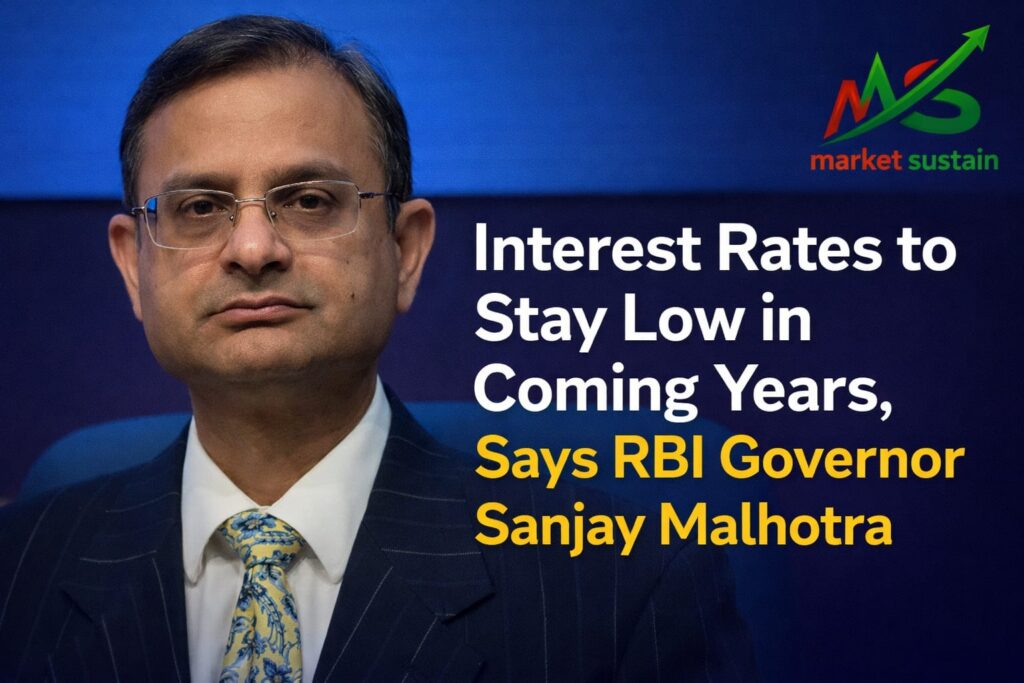
The RBI’s Monetary Policy Committee unanimously voted earlier in the day to take a cautious “wait-and-watch” stance and maintain the benchmark repo rate at 5.25 percent. The decision is made in the midst of increased uncertainty throughout the world, especially in light of the recent tensions in West Asia, which caused the price of crude oil to jump, the rupee to weaken, and trade flows to be disrupted. According to Governor Malhotra, the central bank took the current developments surrounding the ceasefire into account while making its assessment. He pointed out that a calibrated policy approach is required because external shocks, like as geopolitical tensions, continue to pose threats to growth and inflation.
Regarding monetary transmission, the governor stated that banks have reduced lending rates by roughly 90 basis points while the repo rate has been lowered by a total of 125 basis points. Transmission has surpassed 100 basis points on the deposit side, which he deemed satisfactory. Governor Malhotra addressed worries about currency market measures by clarifying that the RBI’s actions were intended to reduce excessive rupee volatility and were not structural in character. He reaffirmed the central bank’s dedication to expanding and strengthening financial markets while stating that such short-term policies won’t last forever. The governor of the RBI emphasized that despite recent fluctuations in the foreign exchange market, India’s macroeconomic fundamentals are still solid, offering stability and promoting long-term economic growth.
