

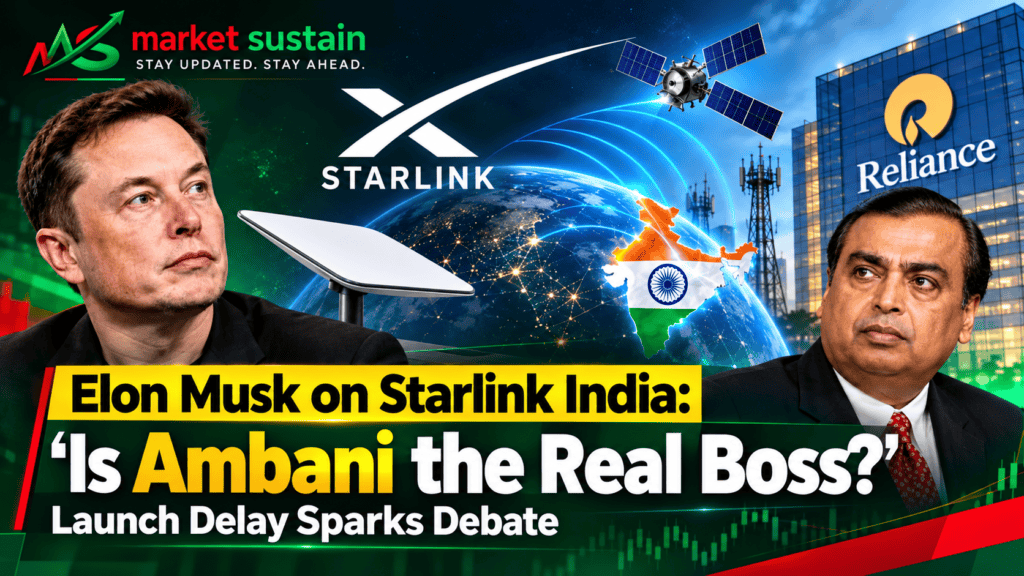
New Delhi, October 9, 2026: Asked about the delay in final approvals for Starlink’s commercial satellite internet services in India, SpaceX chief executive Elon Musk wondered if Reliance Industries Chairman Mukesh Ambani is “the real boss of India”.
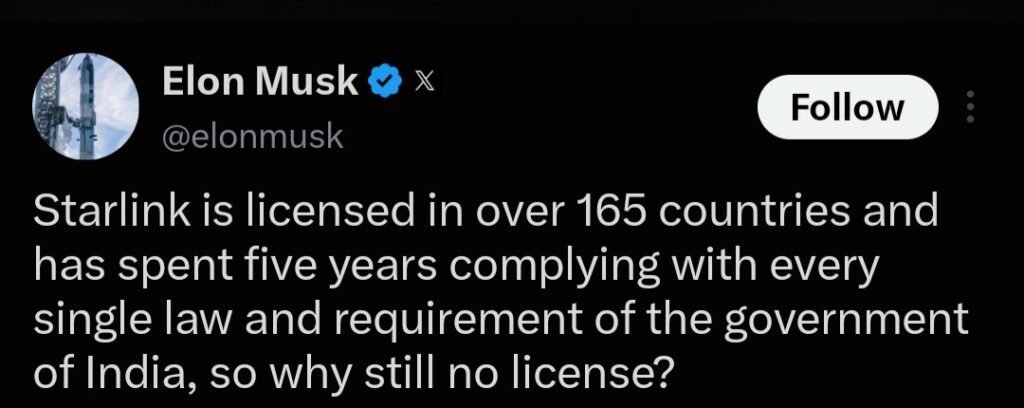
Musk, in a post on his official X account on October 8, said Starlink is licensed in over 165 countries and has spent five years following the laws and requirements of the Indian government.
“Starlink is licensed in more than 165 countries and has spent 5 years complying with every single law and requirement of the Indian government, so why still no license? Musk tweeted.
He followed the statement with a sharp question: “Is Ambani the real boss of India?”
The post added fuel to the debate on Starlink’s entry into India, regulatory approvals and competition in the country’s growing satellite communications market. See Musk’s post on X (https://x.com/elonmusk/status/2108187065687118261)
Business interests are stopping Starlink, says Elon Musk
Musk made the latest comments after an earlier post in which he alleged that unnamed powerful business interests were blocking Starlink from entering India to protect their market share.
He described the alleged obstruction as a “monopolistic chokehold” on consumers in India, saying Starlink could help those who lack access to reliable or affordable internet.
Musk did not name any company at the start but his subsequent mention of Mukesh Ambani brought the debate to bear on India’s telecommunications industry.
But Musk’s claims have not been independently verified as fact. India’s satellite communication approval framework is not unfair or discriminatory, the government has dismissed claims.
What was the response of the Indian government?
India’s Ministry of Communications said the regulatory framework for satellite communication services is “equitable and non-discriminatory”.
The ministry said three satellite communication licensees are undergoing security checks. All three are at a similar regulatory stage, and companies can move forward toward spectrum assignment once the required security process is completed.
The ministry also dismissed the notion that the framework or its implementation is unduly beneficial to some companies.
This means that even with the critical first authorization from Starlink, the ultimate security and spectrum conditions still matter for its commercial launch.
Jio, Starlink and OneWeb: What’s the situation?
The satellite internet market in India has a number of players trying to provide connectivity over satellite networks.
- Starlink: A SpaceX project to provide satellite broadband service, particularly in remote and underserved areas.
- Jio Satcom: Reliance Jio is looking at satellite communication services as part of its overall connectivity business.
- Eutelsat One Web: The satellite communications business is backed by Bharti Enterprises, which also has a stake in Airtel.
The companies concerned had to comply with security requirements before proceeding with the next phases of authorization and spectrum allocation, the government said.
So the delay should not be considered only as a constraint on Starlink.
What makes Starlink’s entry important for India?
Satellite internet could help improve connectivity in remote villages, mountainous regions, border areas and places where traditional broadband infrastructure is difficult to lay.
Musk has said that Starlink could deliver high-speed internet to those who either lack access to reliable connections today or can’t afford current options.
The real benefits for Indian consumers, however, will hinge on subscription prices, equipment costs, network coverage, service quality and timing of commercial availability.
It should not be assumed until a final launch date and consumer pricing has been confirmed by the company or relevant authorities.
So what happens next?
The next major steps will depend on completing the necessary security assessments and spectrum-related processes.
The dispute also raises a larger question for India’s telecommunications sector: how to encourage competition and connectivity, while still maintaining regulatory oversight and national security safeguards.
Musk’s post has only added fuel to the debate on the delayed commercial launch of Starlink, but the most important question remains unanswered. When will the company get all approvals to start services in India?
Conclusion: With Elon Musk’s direct question to Mukesh Ambani, the spotlight has returned to Starlink’s India plans and the country’s satellite internet approval process. The rules are fair, the government says, and security checks are underway on all three licensees. The outcome may impact competition and connectivity choices in satellite broadband market in India.
Stay informed with Market Sustain for all the latest business, technology and world market news.
