
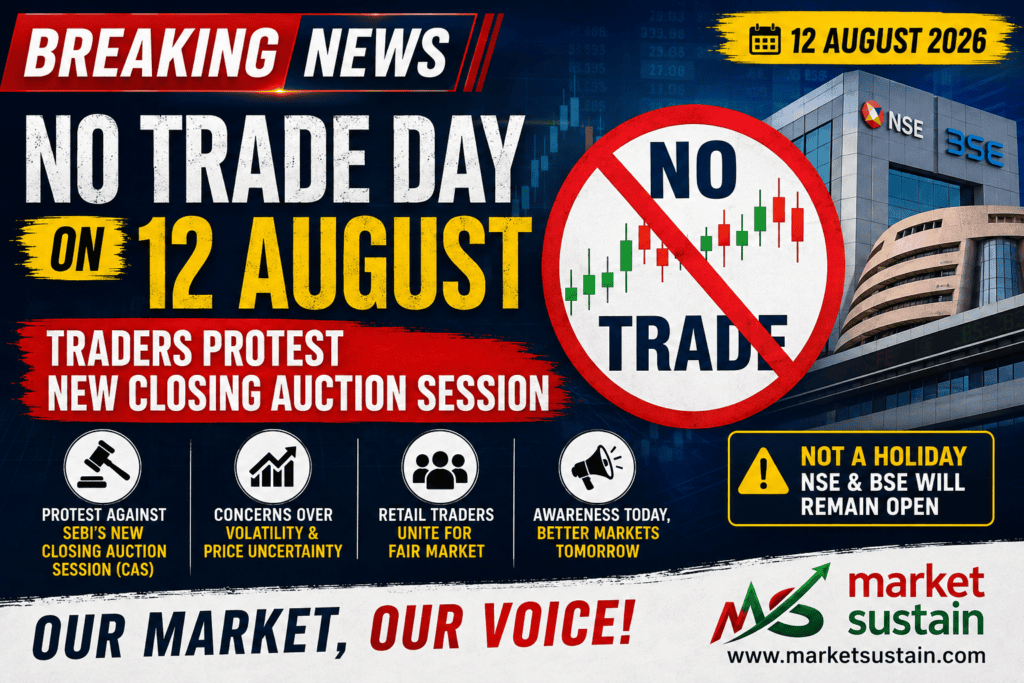
New Delhi, August 12, 2026: A segment of India’s retail trading community is marking “No Trade Day” on August 12 to protest the Securities and Exchange Board of India’s (SEBI) newly introduced Closing Auction Session (CAS) mechanism.
This initiative aims to raise awareness about the concerns traders have regarding the effects of the new closing-price discovery system on retail participants, intraday traders, and derivatives trading.
What Is No Trade Day?
“No Trade Day” is a voluntary initiative led by traders, rather than an official stock-market holiday. The NSE and BSE will remain open for trading on August 12, 2026, as this date is not recognized as an official holiday by the exchanges.
Traders backing this campaign are encouraging market participants to refrain from trading for one day as a protest against the implementation of CAS.
Why Are Traders Opposing CAS?
The new Closing Auction Session was designed to alter the method of closing price discovery for eligible securities. This mechanism aims to enhance transparency and improve price discovery.
Nevertheless, some traders have expressed concerns about:
– Increased volatility during the closing period
– Uncertainty regarding final execution prices
– The potential discrepancy between the last traded price and the official closing price
– Effects on intraday and leveraged positions
– Possible difficulties for retail traders in adjusting to the new system
What Has SEBI Changed?
With the new system, eligible securities undergo a specific auction-based process to determine their closing price.
SEBI has indicated that this framework is meant to offer a more transparent and efficient closing-price discovery mechanism, aligning Indian markets more closely with international practices.
Is the Stock Market Closed on August 12?
No.
August 12 is not an official trading holiday for NSE or BSE. The exchanges will continue to function according to their regular trading hours.
Therefore, the “No Trade Day” campaign should not be confused with an official market closure.
What Implications Does the Campaign Have for Traders?
The campaign highlights an increasing discussion among traders regarding the potential effects of the new closing mechanism on market liquidity, volatility, and trading strategies.
It is yet to be determined if the protest will lead to a notable decrease in trading activity. The long-term effects of CAS will rely on how market participants adjust and how liquidity and price discovery evolve in the upcoming weeks.
Conclusion
The No Trade Day on August 12 is a voluntary protest initiated by some traders, rather than a formal market holiday. Both NSE and BSE will continue to operate.
It’s crucial for investors and traders to differentiate between a trading boycott driven by social media and an official holiday declared by the exchange before making any trading choices.
DISCLAIMER: This information provided is not trading advice, marketsustain.com holds no liability for any investments made based on the information provided on this page. We strongly recommend independent research and/or consultation with a qualified professional before making any investment decisions.
